
The FuelEU Regulation
FuelEU Maritime (REGULATION (EU) 2023/1805 OF THE EUROPEAN PARLIAMENT AND OF THE COUNCIL), effective from 1 January 2025, is a key element of the EU’s Fit for 55 package, supporting the objective of reaching climate neutrality by 2050 and reducing greenhouse gas emissions by 55 percent by 2030.
The regulation applies to ships above 5,000 GT transporting cargo or passengers within the EU and EEA, and introduces progressively stricter limits on the greenhouse gas intensity of the energy used on board, expressed in gCO₂e/MJ. The requirements begin with a 2% reduction from 2025 to 2029 relative to the 2020 baseline, rise to 6% from 2030 to 2034, and continue to increase until achieving an 80% reduction by 2050.
FuelEU Maritime complements the EU Emissions Trading System and forms part of the broader strategy to decarbonise the maritime sector. To meet these obligations, shipowners can use several compliance options, including banking, borrowing, pooling, and the payment of penalties.
Compliance Mechanism
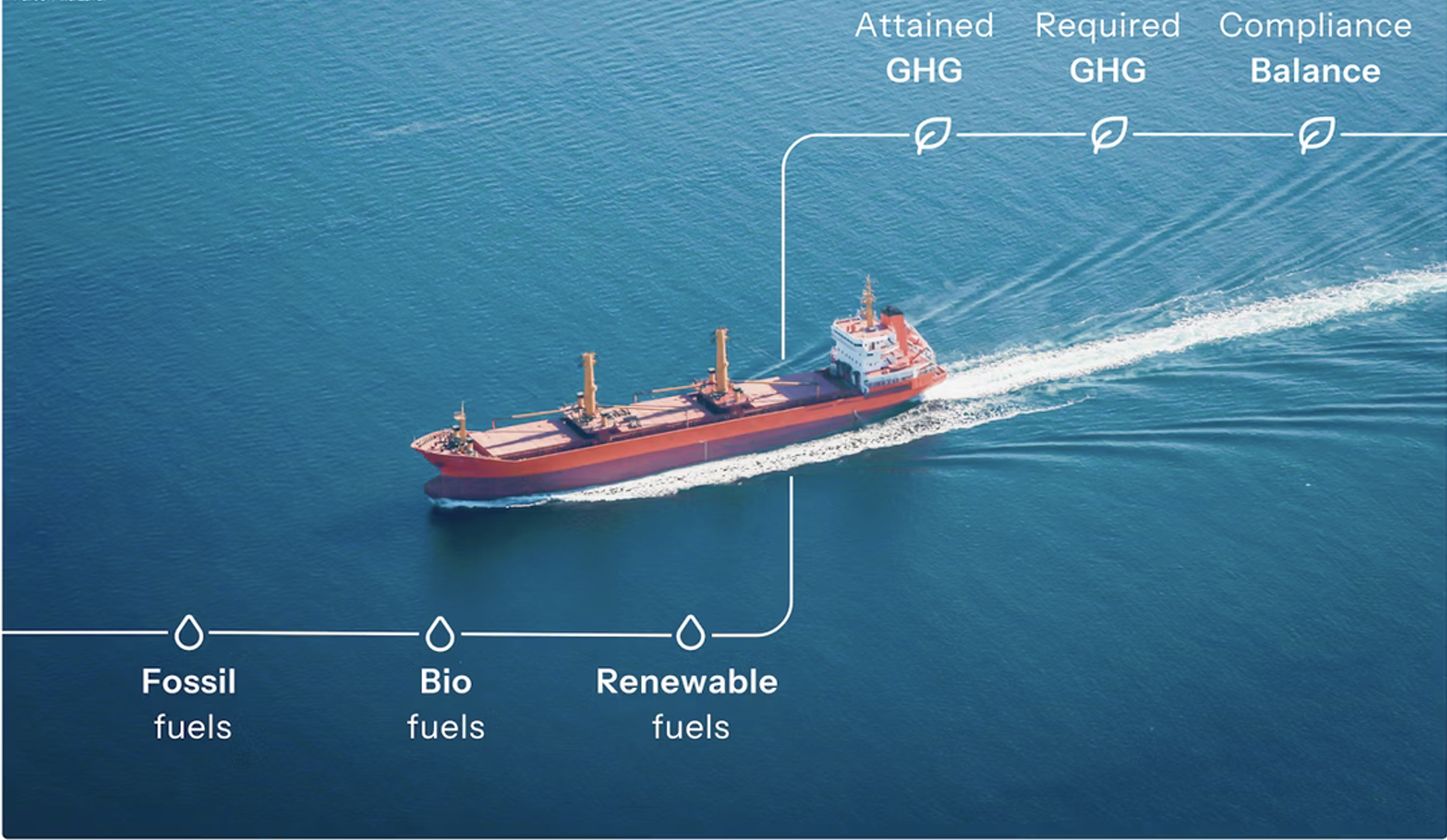
FuelEU offers several alternative compliance mechanisms for ships that do not meet the required GHG intensity. A central element for these mechanisms is the compliance balance which must be calculated for each ship as part of the annual reporting. The compliance balance indicates how far the ship is above or below the required GHG intensity in terms of absolute GHG emissions and can be calculated as follows:
Compliance balance [tCO2eq] =(Required GHG intensity[gCO2/MJ]– Actual GHG intensity[gCO2/MJ]) * ΣEnergy [TJ]
Compliance
Key point
31st of January
Ship-specific FuelEU report (submitted to the verifier for verification and calculation of the results)
January/February
Submission of the Bunker Delivery Notes (BDN) & the Proof of Sustainability (PoS) by the ships owner/manager
31st of March
Verified compliance balance becomes available on THETIS
1st-30th of April
Pooling Period
30th of June
DoC - Document of Compliance for the ship - submitted/verified